Think & Discuss
Quick Check
Inquiry Task
Culture is a constructed and constantly flowing order, not an unchanging bloodline or soul. Take cuisine: chili peppers, tomatoes, and other crops reached many regions’ tables only after early modern global exchange; military and social traditions are likewise continually reshaped through trade, conquest, migration, and the spread of technology. Thus, so-called “pure and unchanging traditions” are often the result of retrospective construction by later generations: they overlook historical external contact and conceal culture’s own history of change. A more reasonable judgment should attend to both continuity and change, rather than treating the appearance at one moment as an eternal essence.
Evaluating this claim requires two kinds of material and qualification. On the evidence side: we can examine the long-run expansion of trade, empires, religion, currency, and shared imagined networks, and ask whether they draw more communities into a single interactive network, thereby reducing the number of mutually independent human worlds. On the qualification side: around 1450, several major human worlds still coexisted—European Christendom, the Islamic world, China and East Asia, India and South Asia, and the civilizations of the Americas—with limited cross-regional contact; and fusion does not equal homogenization, nor does it equal moral progress or improved individual well-being. The conclusion should be framed as a macro-level, statistical, non-predictive trend judgment, not as the assertion that “the world has already become one”; and whether such a trend is welcome is an open normative question that calls for presenting different positions and reasons, rather than a single conclusion.
“Does history have a direction?” is the overarching question for understanding long-term human change. Harari reminds us that “direction” here is not divine arrangement, not inevitable progress, and not some single endpoint; it refers to what can be observed over the long run—observable macro-trends.
So the question is not “Where is history destined to go?” but “Over the several thousand years of recorded history, have the ways human communities organize themselves shown a discernible trajectory?”
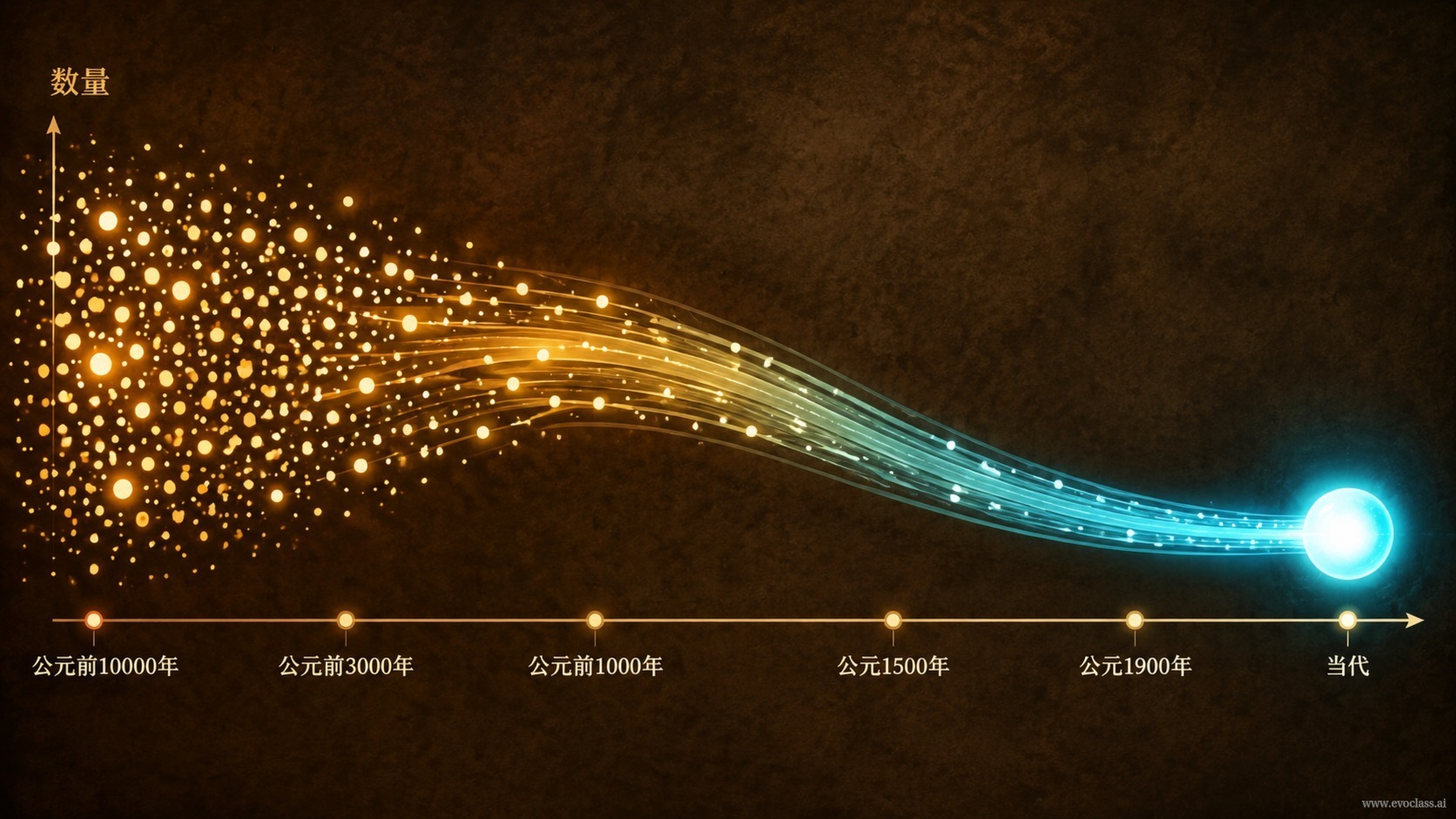
One observable trend is that the number of mutually independent or semi-independent human worlds has fallen from many to few. After the Agricultural Revolution around 10,000 BCE, thousands of small cultural worlds were scattered across the globe; by around 1450 CE, they had contracted into a handful of major civilizations; and by the contemporary period, they have formed a highly connected global system—tracing a trajectory of “long divided, must unite.”
But around 1450 there was not yet “one world.” At least European Christendom, the Islamic world, China and East Asia, India and South Asia, and the civilizations of the Americas coexisted at the time, and cross-regional contact remained limited. Oceanic voyages after 1492, and the Industrial Revolution that followed, further accelerated this convergence. What drew these worlds into a larger network were trade, currency, religion, and empire—imagined orders—which enable strangers who have never met to cooperate on a large scale under the same shared set of beliefs.
The trend is possible only because culture is not a fixed bloodline or soul but a constructed, constantly flowing order; so-calledpure cultureis in fact a myth. External contact (trade, conquest, migration, disease, technology) and internal contradictions together drive the reorganization of culture.
Internal contradictions are especially crucial: cultures often contain values that cannot be satisfied simultaneously, producing cognitive dissonance and political tension. Medieval chivalry emphasized honor, violence, and hierarchical loyalty, which clashed with Christian ideals of peace, charity, and just war; these contradictions appeared in the Crusades, church reform, chivalric literature, and royal competition. The modern tension between liberty and equality manifests as political debates over market freedom, individual rights, redistribution, and social rights.
Finally, remember the limits of direction: a trend toward fusion does not mean homogenization, nor does it mean moral progress or improved individual well-being. It is macro-level, statistical, and non-predictive; concrete history is still shaped by contingency, power, and choice.
Does History Have a Direction?Using the diagram—a simple chart from 10,000 BCE to the present—mark the trend of the number of human worlds declining from many to few, and describe the key points you observe.